
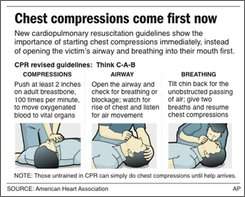
New CPR Guidelines!
Given the fact that we here at UpaDowna love being in secluded areas, usually deep in the backcountry it is of the utmost importance that we stay current on our understanding of the best methods to handle emergencies. No where in the world do you have as many potentially dangerous situations presented as you do while traveling alone or in a small group far away from all outside help. Fortunately the majority of backcountry freaks stay aware and are usually cautious to avoid potentially life ending mistakes.
The reason for this diligence in expanding our knowledge base is to give us what ever advantage we can in the event something tragic occurs. So please take note study and memorize the new CPR guidelines.
Under the revised guidelines, rescuers using traditional CPR, or cardiopulmonary resuscitation, should start chest compressions immediately — 30 chest compressions, then two breaths. The change applies to adults and children, but not newborns.
One thing of note: There is a bit of controversy about this method because some doctors feel that hands only CPR should be the standard except in a few circumstances such as a near drowning, overdose or if it is evident that the cause of the cardiac arrest is based on a lack of oxygen.
The new regulations also recommend a greater depth in compression up to 2″ on adults, but that is what I was always taught so I assume that folks were just reluctant to compress deep enough for fear of hearing the ribs snap. The compressions should still be given at the rate of about 100/minute, to which I was taught to sing the BeeGee’s “Staying Alive” and give compressions with the beat.
These standards apply to one person rescuer scenarios, I assume the old two person compression/breath rate still applies.
